photos: Toni Hafkenscheid
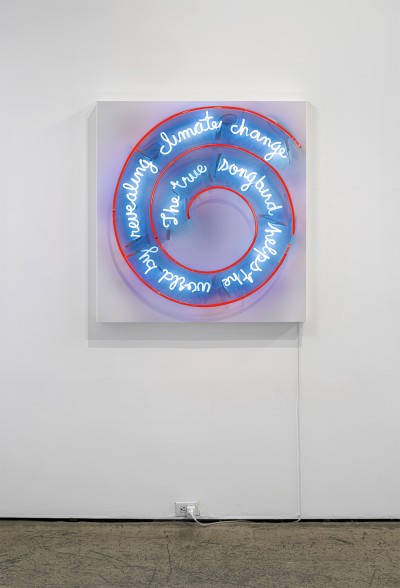
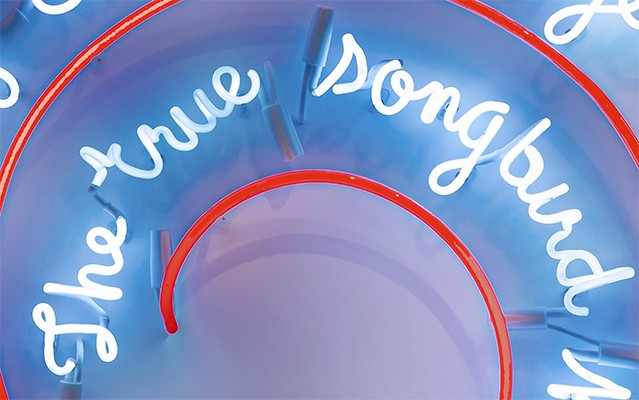
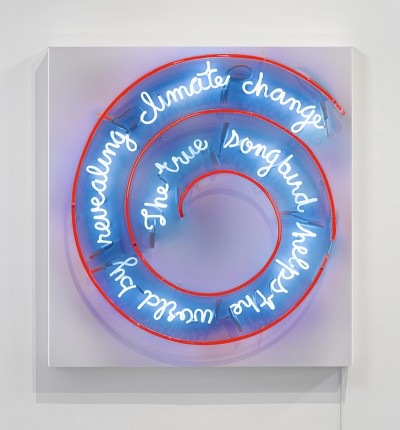
and no birds sing (afterworks 4... Nauman, Carson), 2024
neon, acrylic, transformers
39” x 42” x 4”
"afterworks" is a series of sculptures made in response to works made by 20th century male modernist artists (Picasso, trophy after Picasso ll, 2014; Man Ray, solving man ray’s obstruction, 2012; Duchamp, nudging marcel, 2014). The latest homage/translation positions artist Bruce Nauman’s neon sign, The True Artist Helps the World by Revealing Mystic Truths (1967), within the legacy of conservationist Rachel Carson's seminal text "Silent Spring" (1962).
Nauman’s enigmatic The True Artist Helps the World by Revealing Mystic Truths elevates the role of the artist to noble, helping humanity. The relational neon sign, and no birds sing (afterworks 4…Nauman, Carson), uses the former to draw into question our environmental responsibility to species in this time of mass extinction.
The concept/context/meaning of this work is again succinctly unpacked in Bojana Videkanic's exhibition essay:
"in and no birds sing (afterworks 4…Nauman, Carson) she constructs an imaginary conversation between artist Bruce Nauman and conservationist Rachel Carson. The work offers not only a critique of Bruce Nauman’s neon text piece The True Artist Helps the World by Revealing Mystic Truths (1967), but of art’s purpose in a world faced with ecological catastrophe. Echoing Rachel Carson’s book Silent Spring (1962)[1] in its title, this neon sculpture removes the mysticism of the male artist’s ego replacing it with a seemingly simple statement: “The true songbird helps the world by revealing climate change.” The challenge posed by the statement is clear: is there a need for art in a world that is falling apart? The answers are difficult yet necessary, as no human can be outside the responsibility for ecological destruction we are causing. By proposing a displacement of the subject-object (human-nature; human-animal; dominant-dominated) dichotomy and proposing that the world and nature are far more powerful, messier, and vulnerable, Andison challenges our sense of Self. Barad suggests that we are dependent; we are not single, isolated free agents, but deeply entangled beings whose lives are changed and wounded with the death of ecosystem. This rather sobering truth is revealed in pieces of you are pieces of me, however, hope is also revealed."
[1] Rachel Carson, Silent Spring, (Boston: Houghton Mifflin Company, 1962).
Exhibition History
2024 pieces of you are pieces of me, Olga Korper Gallery, Toronto, Ontario.