photos: Toni Hafkenscheid
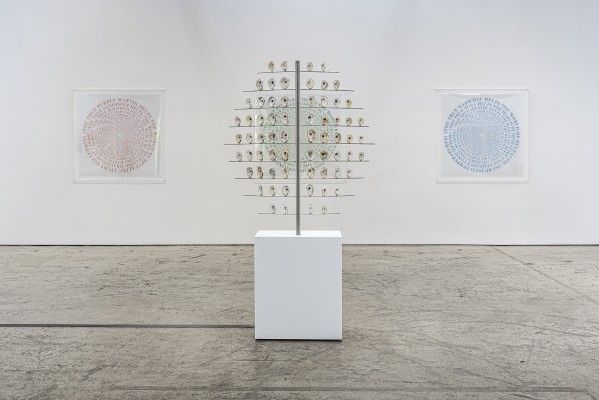
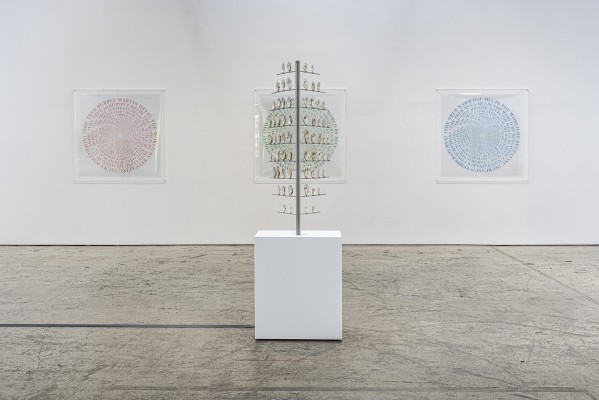
shell shield, 2024
excavated oyster shells, stainless steel rod and shafts, custom
mechanics and electronics, acrylic stand
mechanical design & machining: Paul Cahill
programming: Ian Phillips
49.5” x 76.9” x 18”
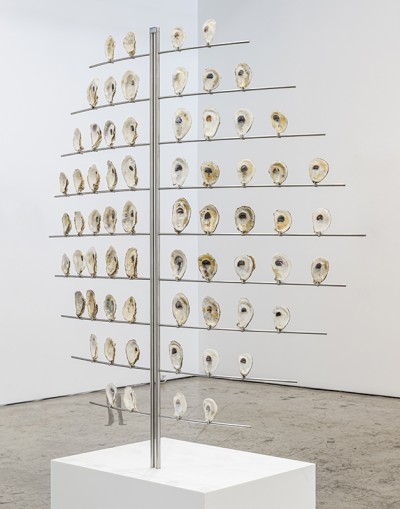
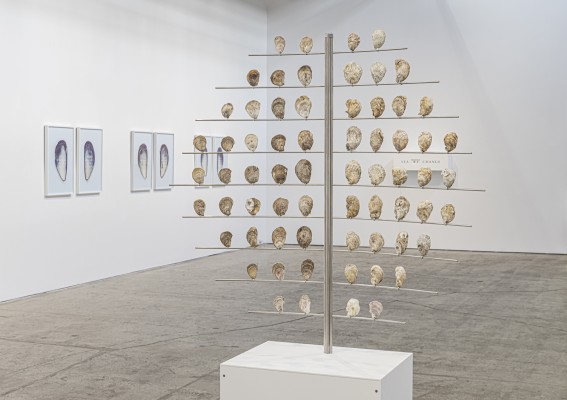
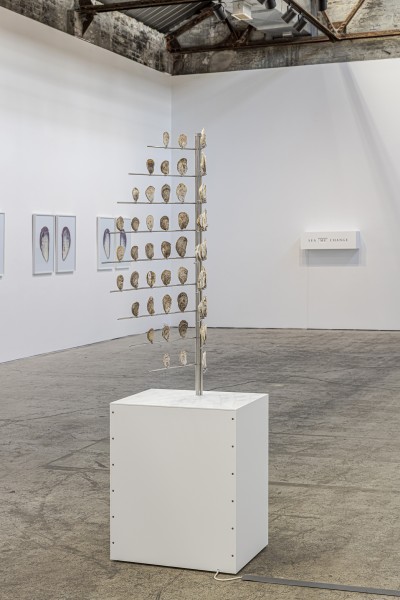
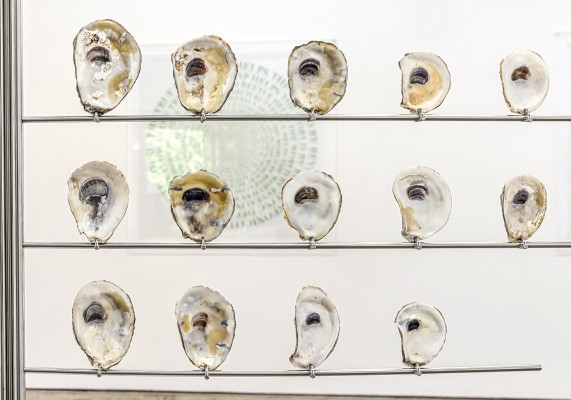
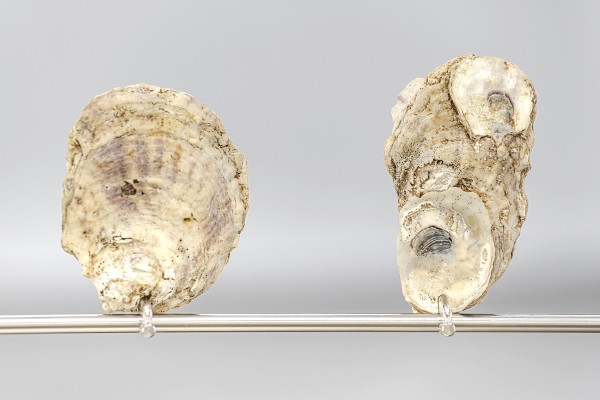
In the kinetic sculpture, shell shield, oyster shells, excavated from our garden (buried beneath the trees), are assembled in nine rows of varying lengths of stainless steel rod to form an oval-shaped shield. The shield is divided—the left side is filled with cupped shells and the right side is filled with flat shells. Both sides are motorized and open and close in unison. In the rest position, the sides fold to the back of the sculpture. Once the sensor is activated when the viewer approaches, the shield slowly unfolds to a frontal stance of protection.
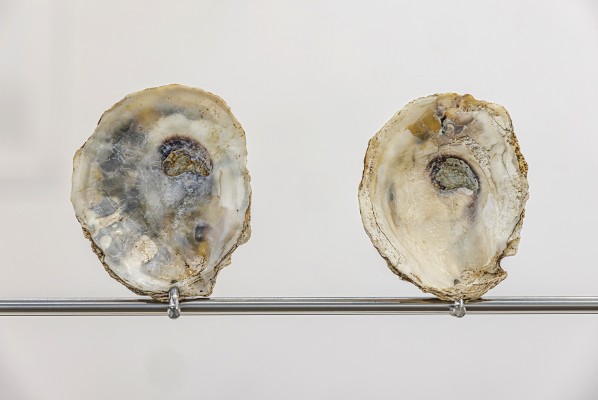
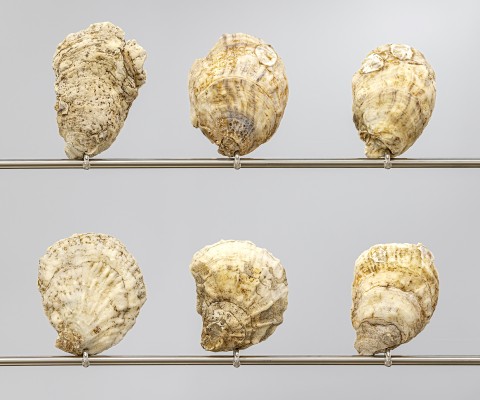
Like the shell that once housed a delicate creature, which was extracted and consumed, the shield represents armour—a barrier. Set in formation, with equal spacing between, the shells are individuated to reveal their uniqueness. The smooth inside of the shell, which faces the viewer, has the oyster adductor muscle attachment which resembles the shape/presence of an eye. That eye is now turned towards the human in an act of resistance and defiance—nature protecting nature. Both inside and outside surfaces have forms of patina that belie their histories. The back of the shell is weathered and, in some instances, perforated by small circular holes likely caused by the oyster drill.
The custom-machined stainless attachments that secure the shell in position on the rod are delcately desgned and crafted to have a jewel-like quality.
In her thoughtful essay on the exhibition pieces of you are pieces of me, artist, curator, art historian Bojana Videkanic writes:
"Excavated from the artist’s garden, mussel and oyster shells were lovingly cleaned, polished, and documented. shell shield is a sculpture constructed of oysters which have been arranged in a shield-like formation. Both oysters and mussels are considered “keystone species,”[1] and “ecological engineers” because of their extraordinary impact on the habitat. [2] As such they are indispensable to coastal ecosystems, providing “shelter and refuge for other species” serving as a shield from water currents and invasive species.[1] The shells are also a shield for the animal’s soft, vulnerable body which the two halves of the shell protect giving its bivalvial structure. Echoing this ecological function played in coastal ecosystems, Andison’s shell shield is equally[LA1] parts strong (literally made up of shells mounted on a metal structure) and delicate. In their second life as sculptures, the oysters and mussels slowly move and breathe creating a sophisticated choreography of life. However, unlike in their natural state, in Andison’s work the two species move outside their proscribed biological functions, slowly moving up and down in second life, almost like synchronized swimmers or gymnasts, and in shell shield they move in unison as if part of a large set of lungs.
[1] Scott L Mills, Michael E. Soule, and Daniel F. Doak, "The Keystone-Species Concept in Ecology and Conservation," BioScience, 43 (4) (1993): 219.
[2] Erin Spencer, “What’s the Difference Between Clams, Mussels, and Oysters?” Ocean Conservancy Blog, March 19, 2021. https://oceanconservancy.org/blog/2021/03/19/clams-mussels-oysters/ Last Accessed: June 4, 2024; Bayne, L. “Chapter 10 - Oysters and the Ecosystem.” Brian Bayne, ed. Developments in Aquaculture and Fisheries Science, Elsevier, Vol. 41, (2017): 703-834.
[3] Bayne, L., “Chapter 10 - Oysters and the Ecosystem,” 707.
Exhibition History
2024 pieces of you are pieces of me, Olga Korper Gallery, Toronto, Ontario.